Aerial Fiber Construction
Strand placement, overlash, make-ready, and pole work, at scale, on the schedule your build demands.
Aerial is the fastest, most cost-efficient path to deliver broadband across most of the country, and it is where a build either keeps pace or falls behind. FCC fields experienced aerial crews and vetted partners to run greenfield strand, overlash, and make-ready programs at the capacity your build window needs, with the engineering and safety discipline carriers expect on every span.
The aerial scope FCC builds
FCC runs the aerial lifecycle from route walk-out through final placement and turn-up. Overbuild an existing pole route for an FTTH program or run greenfield strand for a long-haul carrier, and the same crews, equipment, and supervision keep the work moving span to span. When a route could run either way, the trade-offs between an aerial and an underground build come down to cost, speed, and permitting, which we break down in aerial vs underground fiber construction.
- Strand placement and tensioning, single- and multi-span
- Static and dynamic lashing for fiber, copper, and hybrid cable
- Overlash on existing fiber and copper routes
- Make-ready engineering, structural analysis, and pole replacement coordination
- Pole transfers, anchor installation, and guying
- Storm hardening and emergency cable replacement
- MUTCD traffic control on roadway-adjacent work
- Bidirectional OTDR certification and GIS as-builts
Strand, lashing, and overlash
Strand goes up to tension and clearance, not just up. FCC places and tensions strand across single- and multi-span runs, lashes fiber, copper, and hybrid cable static or dynamic, and overlashes existing routes where the pole line already carries plant. Overlash is its own discipline: the existing attachment has to take the load, and FCC verifies that against the make-ready before a crew adds weight to a span.
Make-ready and pole work
Most aerial schedules slip on make-ready, not placement. FCC runs make-ready engineering, structural analysis, and pole-replacement coordination, and self-performs the pole transfers, anchors, and guying the route needs. Attachment conflicts get surfaced during the field walk and worked with the pole owner on the program's timeline, so a crew arrives at a span that is ready to build instead of one waiting on a transfer.
The route walk comes first
Every aerial program at FCC opens with field verification. Crews walk the route, validate the engineering package, identify make-ready conflicts, and surface attachment issues before mobilization. From there, crew leads run daily field reports, weekly program reviews, and clean cost-coding, so a program manager knows where the build stands at any point instead of at the next milestone.
Certification and as-builts
FCC closes every span with bidirectional OTDR certification through its splice-and-test team, hands over GIS-tracked as-builts, and completes the joint-use paperwork loop with pole owners. The span that shows complete is certified, documented, and cleared with the pole owner, so acceptance and joint-use billing don't come back as open items after the crew has left the market.
Where aerial fits in the OSP build
Aerial ties into the rest of the plant. The underground it transitions to, the splice work that lights it, and the engineering that permits the attachments all sit in the same program. FCC builds across the full Outside Plant lifecycle, so the aerial release shares crews, supervision, and reporting with the underground construction it meets, the splicing and OTDR testing that accepts it, and the engineering and permitting that clears the make-ready. One contractor across the build means one closeout standard and one supervisor accountable from the pole to the splice.
Safety and standards
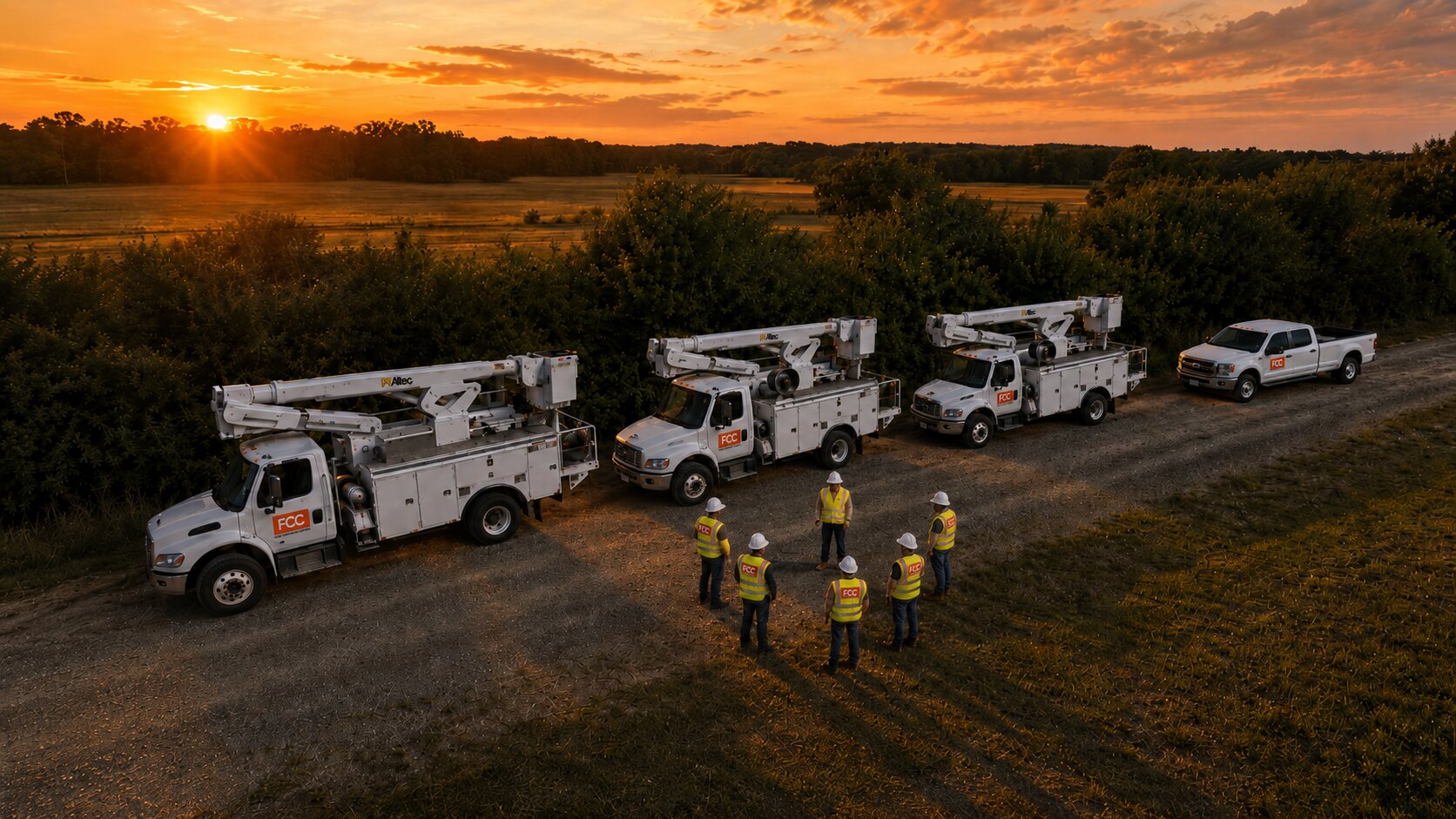
FCC aerial work runs to NESC across attachment heights, clearances, and grounding. Every supervisor and crew lead carries OSHA 30, crews open the day with a job-safety analysis, and the dielectric, fall-arrest, and aerial-lift certifications carrier and joint-use partners require stay current. The fleet runs single- and double-bucket trucks, digger-derricks, reel and stringing trailers, and splice trailers, owned by FCC and supplemented through vetted construction partners when capacity demands, and every truck rolls with the documentation, PPE, and traffic-control gear to start the minute it arrives.
Aerial fiber construction, answered
What aerial work does FCC self-perform?
Strand placement and tensioning, static and dynamic lashing, overlash, make-ready, pole transfers, anchors, and guying.
Do you overlash existing routes?
Yes, after verifying the existing attachment carries the added load against the make-ready.
Do you handle make-ready and joint-use?
Make-ready engineering, structural analysis, pole-replacement coordination, and the joint-use paperwork loop with the pole owner.
How are spans certified?
Bidirectional OTDR certification through FCC's splice-and-test team, with GIS-tracked as-builts in the program's format.
Can you scale crews to a build window?
Owned FCC crews plus vetted construction partners, run to one standard and staffed to the schedule.
Do you do storm hardening and emergency replacement?
Yes, storm hardening on new and existing plant, and emergency cable replacement through the restoration program.
Where does FCC build?
All 50 states and the U.S. territories, out of Austin, Texas.
The rest of the build.
FCC delivers across the full Outside Plant lifecycle. Here's where this service connects to the rest of the program.