
Fiber Splicing Services & OTDR Testing
Fusion splicing, OTDR bidirectional certification, and rapid restoration response.
Splicing and testing is where a build holds up under acceptance or doesn't. FCC's splice and test crews carry the fusion gear, the OTDR sets, and the splice-trailer infrastructure to certify spans bidirectionally, document loss budgets, and turn over fiber that drops cleanly into the carrier's OSS. High-count backbone closure, metro distribution hub, or a rapid restoration after a hit, the splice teams mobilize to keep the spans on schedule.
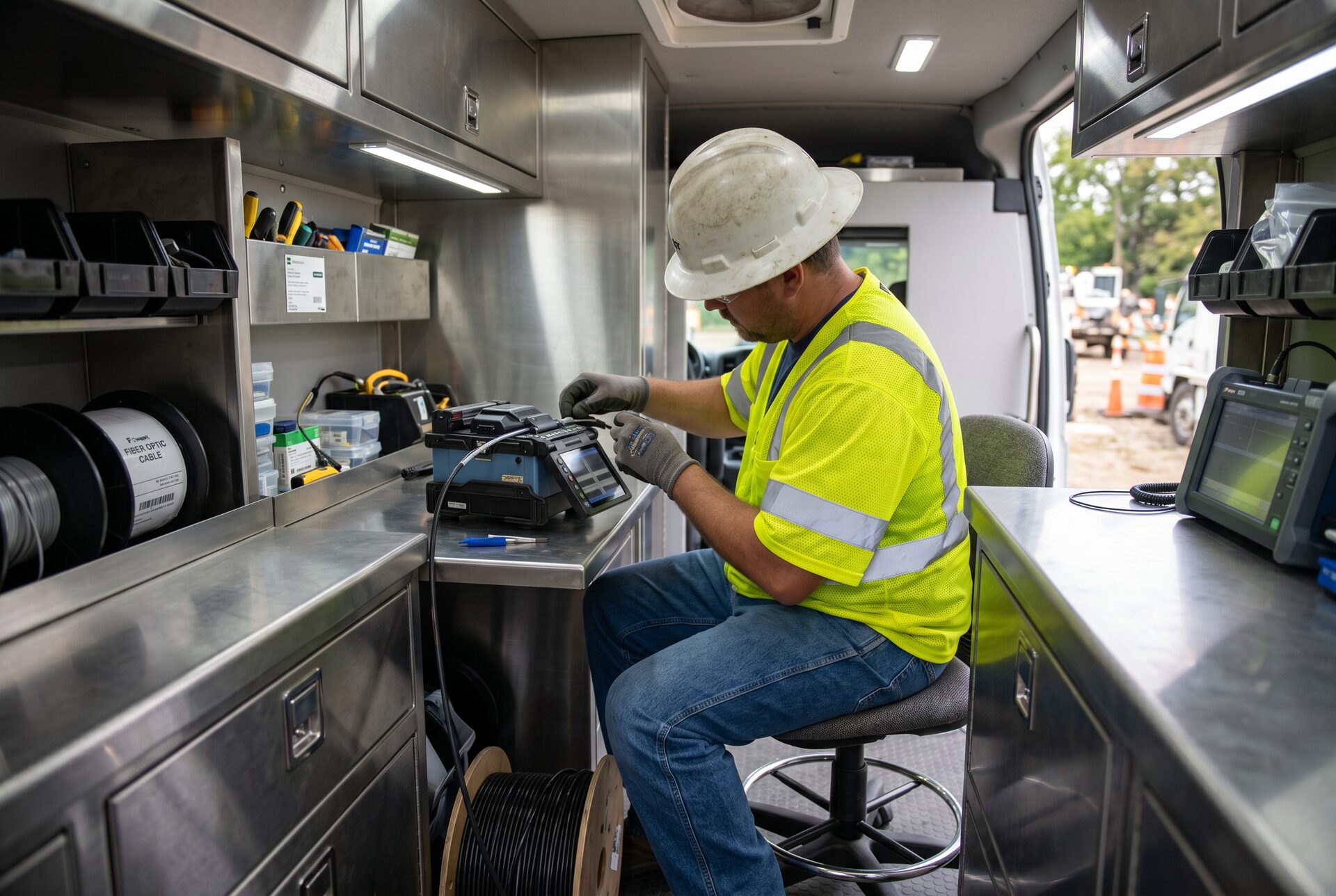
The splice and test scope FCC builds
FCC splice teams handle single-fiber and ribbon fusion across counts from drop-level FTTH to 864-fiber long-haul. Every closure is OTDR-certified bidirectionally, every span carries end-to-end loss readings, and every result comes back in the format the program uses: TIA-compliant reports, vendor dashboards, or a straight-to-OSS handoff.
- Single-fiber and ribbon fusion splicing, 12F through 864F
- OTDR bidirectional certification with launch and tail spools
- End-to-end attenuation, loss-budget, and link-loss testing
- Cable proof testing (CPT) on long-haul placements
- Splice-trailer deployment for high-count enclosures
- Field splice-case reentry, rework, and audit splicing
- Rapid emergency splice response and restoration
- OSS-ready deliverables, TIA and vendor-specific
Fusion splicing across the count range
Count discipline separates a clean splice program from a callback machine. FCC runs single-fiber and ribbon fusion from FTTH drop closures through 864F backbone enclosures, tracing every fiber and photographing every closure before it's sealed. Reentry, rework, and audit splicing on existing closures are part of the scope, so a program with a documentation gap gets it closed instead of carried.
OTDR certification and loss budgets
A span passes on the trace, not the eyeball. FCC certifies bidirectionally with launch and tail spools, documents end-to-end attenuation against the loss budget, and runs cable proof testing on long-haul placements. Results tie to the span and the closure they belong to, so an acceptance question resolves against the file instead of a re-roll, and the buyer's OSS gets data it can trust on the first load.
Splice trailers keep the season
Weather is what puts a long-haul splice schedule at risk. FCC's trailer-based splice shelters keep teams productive in cold, rain, and dust, so a high-count enclosure gets built to spec instead of rushed between storms. On backbone work where a lost week compounds, that shelter is the difference between holding the sequence and slipping it.
Emergency splice response
When a hit takes a span out of service, splicing is the clock. FCC splice crews mobilize fast, paired with the restoration program for detailed restoration documentation when the event qualifies. The same crews that certify a planned build restore an emergency one, so the fiber comes back to service on the same standard it was accepted under.
Where splicing fits in the OSP build
FCC runs fusion inside its own programs, not as a subcontractor afterthought. Splice plans are built off the engineered route package, sequenced against placement, and tracked with the same daily reporting and weekly reviews as the rest of the build. That ties splicing to the aerial and underground construction it accepts and the engineering that routes it, so acceptance keeps pace with placement instead of stacking up behind it.
Standards and equipment
Test gear runs to current TIA and FOTP standards. OTDRs are calibrated quarterly and fusion machines kept in factory spec and revision-tracked. Crews carry OSHA 30, the cleanliness discipline long-haul work demands, and the documentation hygiene a buyer expects when an audit hits. The result is a test record that holds up to the sample pull, not one that gets rebuilt after acceptance.
Fiber splicing and testing, answered
What fiber counts does FCC splice?
Single-fiber and ribbon fusion from FTTH drop closures through 864-fiber long-haul enclosures.
How do you certify a span?
Bidirectional OTDR with launch and tail spools, end-to-end loss-budget testing, and cable proof testing on long-haul placements.
What format do test results come in?
TIA-compliant reports, vendor-specific dashboards, or a straight-to-OSS handoff, whichever your program uses.
Do you do reentry and audit splicing?
Yes. Field splice-case reentry, rework, and audit splicing on existing closures, documented and sealed back into the as-built.
Do you respond to emergency splice calls?
Yes, paired with FCC's restoration program and detailed documentation when the event qualifies.
How is test gear maintained?
To TIA and FOTP standards, OTDRs calibrated quarterly, fusion machines in factory spec and revision-tracked.
Where does FCC build?
All 50 states and the U.S. territories, out of Austin, Texas.
The rest of the build.
FCC delivers across the full Outside Plant lifecycle. Here's where this service connects to the rest of the program.