
Underground Fiber Construction & Directional Boring
HDD, plow, trench, microtrench, and vault placement, wherever the route demands.
Underground fiber construction is where program risk concentrates. Locate accuracy, restoration quality, traffic control, and bore documentation are the difference between a program that closes on schedule and one that loses a season to rework. FCC runs the full spectrum of placement methods, directional drilling, mechanical plow, open-cut trench, microtrench, and vault work, with the locate discipline and as-built documentation that keep a program auditable from the first bore.
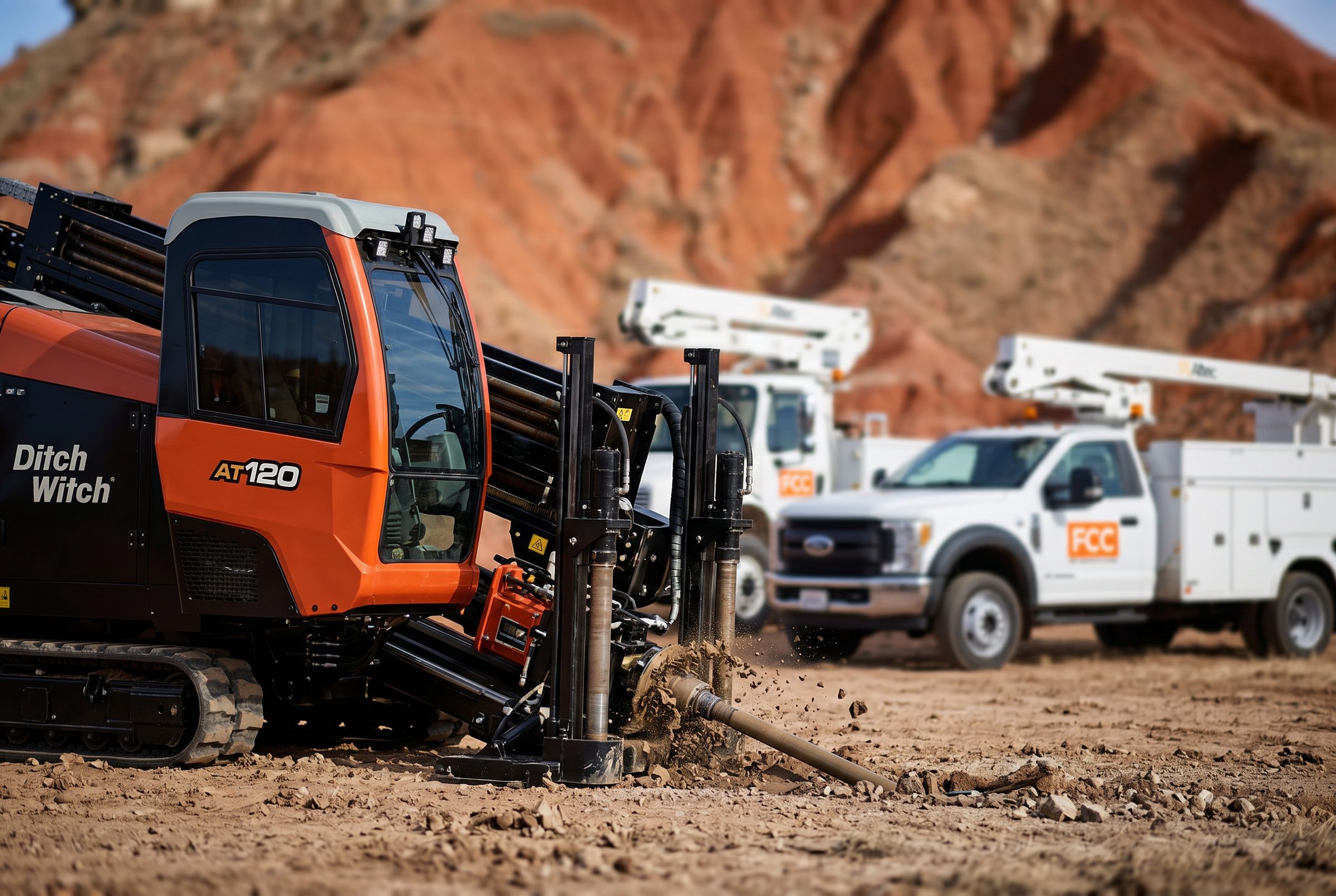
The underground scope FCC builds
From rural long-haul backbone to dense metro overbuild, FCC matches the placement method to terrain, restoration scope, and program economics. The fleet runs directional drills from 2-inch through 12-inch class, vibratory and static plow tractors, rock saws, and microtrenchers, paired with vault, handhole, and pedestal crews and a restoration capability that closes the loop with municipalities and DOT inspectors. Whether a route belongs in the air or the ground turns on terrain, cost, and restoration, a comparison we lay out in aerial versus underground construction.
- Horizontal directional drilling (HDD), 2-inch through 12-inch bores
- Static and vibratory plow on rural and suburban routes
- Open-cut trench and rock saw on hard-rock conditions
- Microtrenching for urban FTTH overbuilds
- Vault, handhole, and pedestal placement
- Full surface restoration: concrete, asphalt, sod, landscape
- MUTCD traffic control and DOT-compliant work zones
- 811 locate management and damage-prevention discipline
HDD and directional boring
Directional drilling is where FCC carries the most weight. Operators run bores from 2-inch utility crossings through 12-inch long-pull intercity runs, in soil, clay, cobble, and rock. Every bore closes with a log that captures entry and exit, depth, deviation, and pull-back, so the plant in the ground matches the plant on the as-built. On hard-rock corridors, rock saws and rock-capable heads keep the route moving instead of stalling at the first refusal.
Rig selection follows the pull. Compact rigs handle tight-quarter urban crossings; Class 4 and 5 drills take the long intercity runs. Owned where it matters, partnered where capacity demands, and run to the same bore-log standard either way.
Plow, trench, and microtrench
Not every route wants a bore. FCC plows where the soil and the route allow it, open-cuts and rock-saws where conditions demand it, and microtrenches urban FTTH overbuilds where restoration cost rules the job. Method follows terrain and the restoration a jurisdiction will accept, so the route goes in at the lowest total cost instead of the lowest placement cost.
Locates and damage prevention
Underground programs live on damage prevention. Every FCC build opens with locate verification, a subsurface utility engineering review, and a daylight-and-pothole pass on the critical conflict points before a drill head turns. 811 tickets get called and honored, and HDD operators carry damage-prevention training specific to directional work. A struck line is a program event, and FCC runs to avoid it rather than to explain it.
Restoration and municipal closeout
Restoration is part of the build, not a phase that trails it. FCC closes concrete, asphalt, sod, and landscape repair, and clears municipal coordination, DOT permits, and final inspections in the same sprint as cable placement. Program managers don't carry restoration risk into close-out, and the jurisdiction signs off while the crew is still in the market.
Bore logs and GIS as-builts
The record is the deliverable. Bore logs, vault and handhole locations, depth-of-cover, and restoration sign-off come back as a GIS-ready as-built in the program's format, so a job pack passes QA on first submission and an as-built question a year later resolves against the file. Clean documentation is also what keeps the next release moving, because a QA team buried in rejects slows every crew behind it.
Where underground fits in the OSP build
Underground rarely moves alone. The aerial plant it ties into, the splice work that lights it, and the engineering that routes and permits it all sit in the same program. FCC builds across the full Outside Plant lifecycle, so the underground release shares crews, supervision, and reporting with the aerial construction it meets, the splicing and OTDR testing that accepts it, and the engineering and permitting that clears the route. One contractor across the build means one closeout standard and one supervisor accountable from the bore pit to the splice.
Safety and standards
FCC underground operations run to OSHA excavation and confined-space standards, MUTCD traffic control, and DOT work-zone requirements. Every crew opens the day with a job-safety analysis against site-specific hazards, and HDD operators carry directional-specific damage-prevention training. The bar holds whether the crew is FCC's or a vetted partner's.
Underground fiber construction, answered
What underground placement methods does FCC self-perform?
HDD, static and vibratory plow, open-cut trench, rock saw, microtrench, and vault, handhole, and pedestal placement.
What size bores can FCC run?
2-inch utility crossings through 12-inch long-pull intercity runs, in soil, clay, cobble, and rock, with Class 4 and 5 rigs on the long pulls.
Do you handle surface restoration?
Yes. Concrete, asphalt, sod, and landscape, with municipal and DOT inspection closed in the same sprint as placement.
How do you document bores?
Bore logs capture entry and exit, depth, deviation, and pull-back, delivered as a GIS-ready as-built in the program's format.
How does FCC prevent utility strikes?
811 locates, a subsurface utility engineering review, potholing and daylighting the critical conflicts, and directional-specific damage-prevention training.
Do you microtrench for urban FTTH?
Yes, on urban overbuilds where restoration cost rules the job.
Where does FCC build?
All 50 states and the U.S. territories, out of Austin, Texas.
The rest of the build.
FCC delivers across the full Outside Plant lifecycle. Here's where this service connects to the rest of the program.