
Emergency Fiber Restoration
Priority dispatch, coordinated crew deployment, and detailed restoration documentation.
When a hit takes a span out of service, a contractor strike, a vehicle into an aerial run, a storm taking down a region, response is measured in hours, not days. FCC runs rapid-response emergency fiber restoration with crews mobilized through vetted construction partners, coordination with carrier partners, and the splice-and-test capability to certify restored spans as fast as the work allows.
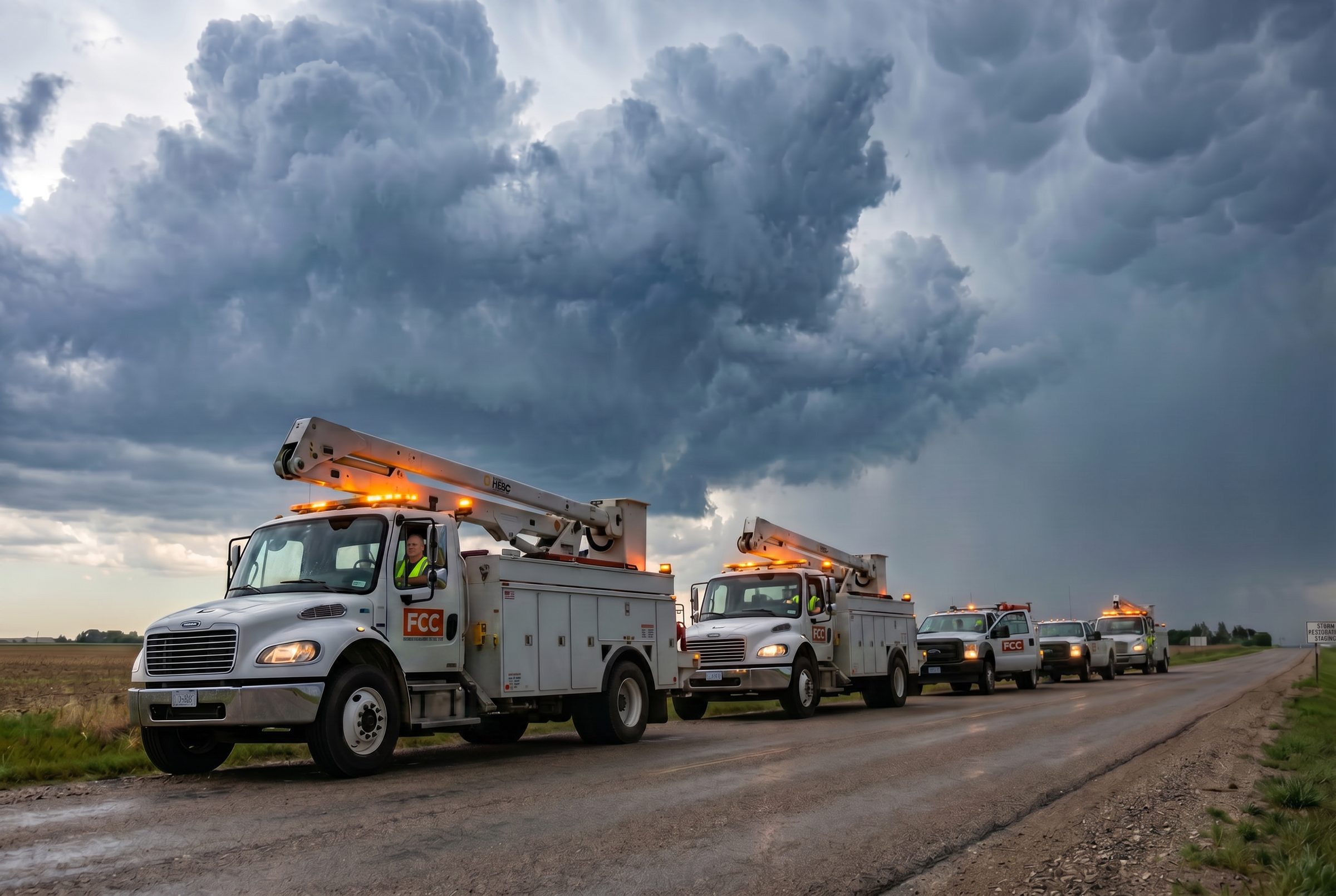
The restoration scope FCC covers
FCC's restoration response runs from a single-span hit to a region-wide event. The dispatch line is monitored on priority, spare cable, fusion gear, splice trailers, and lift equipment mobilize through FCC's vetted construction partners. Every job closes with the documentation the network owner's records and any cost-recovery filing require.
- Priority dispatch and emergency response coordination
- Rapid mobilization for single- and multi-span outages
- Aerial and underground placement during restoration
- On-site fusion splicing and OTDR proof testing
- Coordinated crew deployment for region-wide events
- Detailed cost and event documentation
- Storm hardening and post-event hardening recommendations
- After-action reporting and lessons-learned packages
Dispatch and rapid mobilization
The first hour sets the restoration. When a call comes in, FCC dispatch confirms scope, mobilizes the closest crew, and stays on the line through the response. Spares pull from regional stock, and specialized gear, rock saws, large-diameter HDD, splice trailers, routes to the site as the scope clarifies. The point is to have the crew and the gear moving before the full picture is in, not after.
Restoring the span, then certifying it
A restored span isn't done until it tests. FCC places aerial and underground plant during restoration and sequences field splice teams behind placement, so spans return to service as fast as the damage physically allows. Every restored span gets on-site fusion and OTDR proof testing, so the fiber comes back on the standard it was accepted under rather than a temporary patch that generates a second event.
Surge crews for region-wide events
A regional event outruns any single crew count. FCC coordinates surge crews with carrier partners and pulls from vetted construction partners, so a storm or a catastrophic hit gets the crew volume it needs instead of the crews that happened to be close. Those relationships are what turn a multi-day outage into a faster recovery.
Documentation cost recovery can use
Documentation builds in real time on a restoration: photos, span footages, splice records, and the billing-relevant metrics the event closeout needs. The buyer has what any cost-recovery filing requires without a separate documentation sprint after the crews stand down. After-action reporting and lessons-learned close the loop.
Hardening before the next one
The best restoration is the one that doesn't repeat. FCC handles storm hardening on new and existing plant and returns post-event hardening recommendations after a restoration, so a corridor that took a hit comes back more resilient than it went down. The same crews that restore a span know where it's exposed.
Why the operator-led model shows up at 2 a.m.
Restoration is where the operator-led model pays off. FCC is staffed and trained around what restoration takes: fast dispatch, vetted construction partners for surge crews, dispatch discipline, and the willingness to keep crews in the field as long as the event demands. When the line goes down at 2 a.m., the standard the contractor was built to is the one that shows up.
Emergency fiber restoration, answered
How fast does FCC mobilize?
As fast as the outage location and scope allow, with the closest available crew dispatched on priority and drawn from FCC's vetted construction partners.
Do you restore both aerial and underground?
Yes, with on-site fusion splicing and OTDR proof testing so restored spans return to service certified.
Can you handle region-wide events?
Yes, through coordination with carrier partners and vetted construction partners for crew volume.
What documentation comes with a restoration?
Every restoration closes with real-time documentation for the network owner's records and any cost-recovery filing.
Do you set up restoration coverage in advance?
Yes. Restoration coverage and crew arrangements can be set up ahead of the season through FCC's vetted construction partners, rather than scrambled during an event.
Do you handle storm hardening?
Hardening on new and existing plant, plus post-event hardening recommendations after a restoration.
Where does FCC respond?
All 50 states and the U.S. territories, out of Austin, Texas.
The rest of the build.
FCC delivers across the full Outside Plant lifecycle. Here's where this service connects to the rest of the program.