
FTTx & Last-Mile Fiber Optic Cable Installation
Aerial and buried drops, MDU in-building fiber, and turn-up, built to the owner's acceptance spec and volume.
FCC builds the full FTTx scope: aerial and buried drops, NID and ONT installation, MDU riser and in-building fiber, and turn-up tested to the owner's acceptance spec. FTTH, FTTB, or FTTC, single-family or multi-dwelling, on the production schedule the program is committed to.
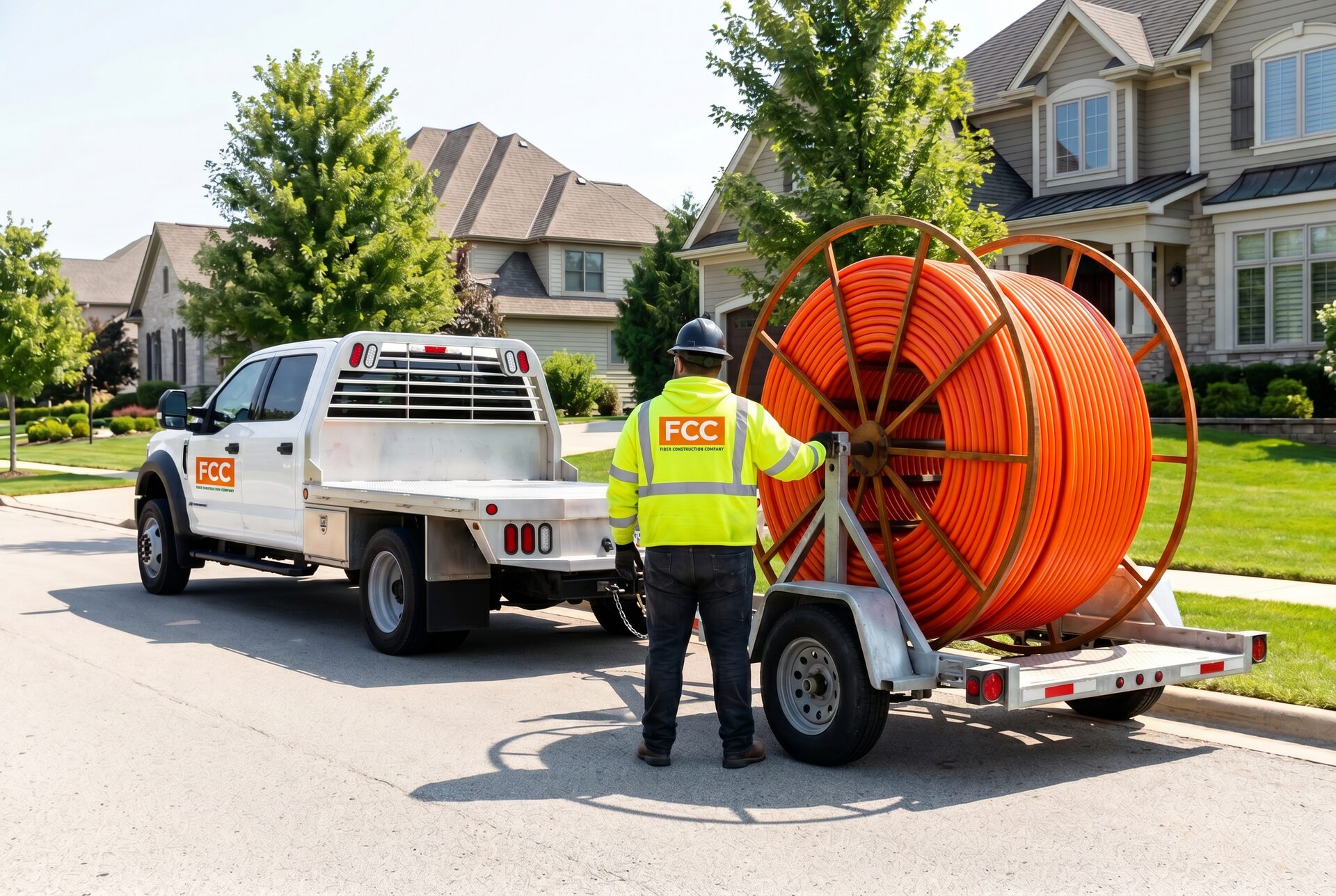
The FTTx scope FCC builds
Every last-mile architecture runs through the same crews. FCC builds drop construction, in-building fiber, and turn-up across single-family and MDU footprints, and integrates splice and OTDR teams so acceptance testing keeps pace with the build.
- SFU drop placement, aerial and buried
- NID and ONT installation, mounting, and grounding
- MDU riser, conduit, and in-building fiber
- Pathway and demarc construction
- Turn-up and OSS handoff
- OTDR acceptance testing and light-level validation
- Premise inspection and exception documentation
- Conversion reporting against program SLAs
Running FTTH construction at volume
A regional FTTH build is a production problem, measured in units per week against a release schedule. FCC staffs crews to the number instead of to availability, and reports scheduled-versus-complete by crew and job pack every day. When a bore hits rock, a riser's locked out, or a permit slips, it escalates that morning, so the area gets re-sequenced before it drags the release date.
Production reporting ties into the program's appointment and OSS systems, so the completion in your dashboard matches the completion in the field. Weekly reviews cover conversion rate, exception aging, and the crews trending behind, with a plan to close the gap before it compounds.
Aerial and buried drops
Most last-mile footprints mix aerial and buried drops, and FCC builds both. Aerial drops run from the strand to the demarc with the clearances and attachment standards the pole owner requires. Buried drops go in by trench, plow, or bore depending on the ground and the surface, restored to the property's condition and the permit's terms.
Drop method follows the ground and the surface. FCC plows where the soil allows it, bores under driveways and roads where it doesn't, and trenches where the restoration favors it, so the drop goes in once and stays in. Crews carry the locate tickets, traffic control, and restoration on the same job, so a drop closes complete instead of leaving a punch item for a second visit.
Make-ready and permitting
Aerial drops wait on make-ready and pole attachments; buried drops wait on right-of-way permits and locates. FCC runs the permitting and make-ready coordination as part of the build, not as a handoff, so the paperwork clears ahead of the crew instead of stranding it. Attachment applications go to the pole owner on the program's timeline, 811 locates get called and honored, and municipal permits track by area so a release doesn't stall behind the one jurisdiction that takes longer to approve.
Turn-up and acceptance testing
FCC tests every turn-up to the owner's acceptance spec: end-to-end OTDR traces, insertion and return loss, and light levels read at the ONT. Crews diagnose and correct failures on the same trip and return the trace files with the closeout, so the acceptance record stands on its own. For programs running third-party audits, the documentation is built to hold up to the sample pull.
Test records travel with the plant. Every trace, loss reading, and light level ties to the address and the drop it belongs to, so an acceptance question months later resolves against the file instead of a re-roll.
MDU and the access problem
In-building fiber stalls on access. FCC builds riser, conduit, and pathway, then the per-unit fiber, and works property management for keys, staging, and resident scheduling so a building closes out instead of sitting half-finished while the market moves past it. MDU work carries its own documentation load, riser diagrams, unit-level as-builts, and management sign-off, and FCC returns it in the same closeout package as the rest of the release.
Mobilizing crews for a release
The question on any award is whether the crew count holds when the volume ramps. FCC runs owned crews and a vetted partner network under one field standard, so a release scales without dropping quality at the edges. Partners onboard to the same safety orientation, the same QC checklist, and the same closeout format as FCC crews, and a supervisor covers the work regardless of whose truck is on site. When a market ramps faster than plan, the partner network absorbs the surge instead of leaving the schedule to slip.
Where FTTx fits in the OSP build
Last-mile rarely moves alone. The distribution and feeder plant it hangs off of, the splice work that lights it, and the engineering that permits it all sit in the same program. FCC builds across the full Outside Plant lifecycle, so the FTTx release shares crews, supervision, and reporting with the aerial and underground construction feeding it, the splicing and OTDR testing that accepts it, and the engineering and permitting that clears it. One contractor across the build means one closeout standard, one reporting format, and one supervisor accountable from the feeder to the ONT.
Closeouts your program can bill against
Most of the friction on a fiber MSA sits in the paperwork. Rejected as-builts stall billing and pile onto your QA team. FCC crews redline in the field and return GIS-ready closeouts: as-builts, splice matrices, OTDR acceptance traces, and photo documentation, in the format your program specifies, so a job pack passes on first submission. Clean documentation is also what keeps the next release moving, because a QA team buried in rejects slows every crew behind it.
Safety and quality on every crew
A construction sub carries the operator's name every time a crew touches the plant, and Tier 1 programs audit for it. Every FCC crew, owned or partner, runs to NESC, holds OSHA 30, works traffic under MUTCD, meets USDOT, and clears E-Verify. Safety runs at the crew level with daily briefings and supervisor coverage sized to the work. Quality runs the same way, with in-process checks that catch a defect at the pole or the pedestal instead of on the acceptance audit.
FTTH & last-mile construction, answered
What is the difference between FTTx and FTTH?
FTTx is the family of fiber architectures. FTTH runs fiber all the way to the home. FCC builds every FTTx type, and most last-mile volume is FTTH.
Do you build MDU in-building fiber?
Yes. Riser, conduit, pathway, and per-unit fiber, including the property-access coordination that stalls most MDU jobs.
Do you self-perform aerial and buried drops?
Both, with locates, traffic control, and restoration handled on the same job so the drop closes complete.
Do you handle permitting and make-ready for drops?
Yes. Pole attachment applications, 811 locates, and municipal permits run as part of the build, tracked by area so approvals stay ahead of the crews.
Can you scale across a regional footprint?
Owned FCC crews and vetted partner crews, run to one standard and staffed to the release volume.
How do closeouts come back?
GIS-ready as-builts, splice matrices, and OTDR acceptance traces in the program's format.
Where does FCC build?
All 50 states and the U.S. territories, out of Austin, Texas.
The rest of the build.
FCC delivers across the full Outside Plant lifecycle. Here's where this service connects to the rest of the program.